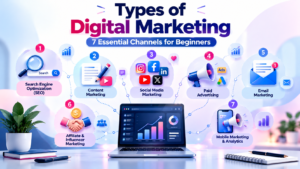
The types of digital marketing help businesses connect with customers through search engines, websites, social media, email, and other online platforms. Each channel serves a different purpose, from increasing brand awareness to attracting website visitors and generating enquiries.
Understanding the types of digital marketing is useful for students, beginners, entrepreneurs, and small business owners who want to build a practical online marketing strategy. Instead of trying every platform at once, you can learn what each channel does and choose the options that match your goals.
In this guide, you will discover seven essential digital marketing channels, how they work, and when businesses can use them.
Table of Contents
- What Are the Types of Digital Marketing?
- Seven Types of Digital Marketing Explained
- How to Choose the Right Digital Marketing Channel
- Types of Digital Marketing for Small Businesses
- Common Mistakes to Avoid
- Frequently Asked Questions
- Conclusion
What Are the Types of Digital Marketing?
The types of digital marketing are different methods businesses use to promote their products, services, or brands through digital channels.
For example, a business might use SEO to attract people searching on Google, social media to communicate with its audience, and email marketing to share updates with subscribers.
Each channel has different strengths. The best choice depends on the target audience, marketing objective, available resources, and the type of product or service being promoted.
Seven Types of Digital Marketing Explained
1. Search Engine Optimization (SEO)
Search Engine Optimization, commonly called SEO, helps search engines understand website content and helps people discover relevant pages through organic search results.
SEO activities include keyword research, improving page titles and headings, creating helpful content, optimizing website structure, and resolving technical issues.
For example, a bakery might publish a useful article about choosing a birthday cake. If the content is relevant and the website performs well, it may attract people searching for cake-related information.
SEO generally requires ongoing effort. Results depend on competition, content quality, website condition, and other factors.
2. Content Marketing
Content marketing involves creating and sharing useful information to attract and engage a defined audience.
Common content formats include:
- Blog articles and educational guides.
- Videos and tutorials.
- Infographics and checklists.
- Case studies based on genuine results.
- Downloadable resources.
For example, a WordPress website can publish beginner-friendly SEO guides that answer common questions. These resources can educate readers and support its broader content strategy.
Content marketing works especially well when the information is useful, relevant, and created for a clear audience need.
3. Social Media Marketing
Social media marketing uses platforms such as Instagram, Facebook, LinkedIn, and YouTube to share content, interact with audiences, and promote products or services.
Businesses can publish educational posts, product demonstrations, short videos, announcements, and customer updates.
For example, a local café could share photographs of its menu, announce seasonal offers, and respond to customer questions.
Choose platforms based on where your audience spends time and what type of content you can create consistently.
4. Search Engine and Paid Advertising
Paid advertising allows businesses to pay for placements that promote their products, services, or content.
Google Ads is one example. Businesses can create campaigns designed to reach people searching for relevant products or services. Meta Ads can help promote content and offers across supported platforms.
Paid advertising can generate visibility quickly, but results depend on factors such as targeting, competition, budget, landing-page quality, and campaign management.
Start with a clear objective and monitor the results before increasing your budget.
5. Email Marketing
Email marketing uses email to communicate with subscribers and customers. Businesses may send newsletters, educational content, product updates, or relevant promotional offers.
For example, an online store could send a welcome email to new subscribers and occasional updates about products they may find useful.
Build your list responsibly, obtain appropriate permission, and make it easy for recipients to unsubscribe.
Email marketing can support customer relationships, but its effectiveness depends on message relevance, audience expectations, and delivery quality.
6. Affiliate and Influencer Marketing
Affiliate marketing involves partners promoting products or services in exchange for an agreed commission or other arrangement.
Influencer marketing involves working with creators whose audiences may be relevant to a business.
For example, a skincare brand might collaborate with a suitable creator to demonstrate a product. An affiliate partner might share a tracked link and receive a commission for qualifying sales.
Businesses should evaluate audience relevance, authenticity, costs, disclosure requirements, and campaign objectives before choosing these methods.
7. Mobile Marketing and Marketing Analytics
Mobile marketing focuses on reaching people through mobile-friendly websites, apps, SMS, and other suitable mobile channels.
Marketing analytics helps businesses understand the performance of their activities. It can show which channels attract visitors, generate enquiries, or contribute to sales.
For example, a business can use analytics to compare website traffic from organic search with traffic from a paid campaign.
These two disciplines serve different purposes: mobile marketing is a way to reach audiences, while analytics helps measure and improve marketing performance.
How to Choose the Right Digital Marketing Channel
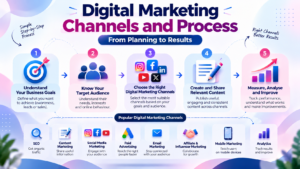
Choosing the right channel starts with your marketing goal.
Match the Channel to Your Goal
- For organic search visibility: Learn SEO and keyword research.
- For audience engagement: Consider relevant social media platforms.
- For educational content: Develop a content marketing plan.
- For targeted promotion: Learn paid advertising fundamentals.
- For ongoing customer communication: Explore email marketing.
- For understanding results: Use appropriate analytics tools.
Consider Your Audience and Resources
Think about your audience’s needs, your available budget, the time required to create content, and the skills you need to develop.
You do not need to use all seven channels at once. Begin with one or two that match your goals, evaluate the results, and expand when it makes sense.
How the Types of Digital Marketing Work Together
The types of digital marketing can complement each other. A blog post can support SEO, be shared through social media, and be included in an email newsletter. Analytics can then help you understand how people interact with the content.
A coordinated approach can make your marketing more consistent, provided each activity has a clear purpose.
Choosing a Channel Based on Business Needs
For a small business with limited resources, a practical starting point may be a well-maintained website, useful content, and one suitable social media channel. Another business may benefit more from email marketing or carefully managed paid advertising.
Choose based on evidence about your audience and goals rather than following every new trend.
Types of Digital Marketing for Small Businesses
Small businesses can use different channels according to their needs.
A local service provider might focus on SEO and local search visibility. An online store might combine product content, social media, email, and paid advertising. An educational website might prioritize helpful articles, keyword research, and analytics.
The important thing is to connect each activity to a business objective and evaluate whether it is delivering useful results.
Common Mistakes to Avoid
When learning the types of digital marketing, avoid these common mistakes:
- Trying to manage every marketing channel at once.
- Publishing content without understanding the audience.
- Running paid campaigns without a clear goal.
- Ignoring mobile usability and website experience.
- Measuring only likes and impressions.
- Expecting immediate results from every channel.
- Repeating keywords unnaturally to improve an SEO score.
A focused strategy and regular review can help you use your time and budget more effectively.
Frequently Asked Questions
What are the main types of digital marketing?
Common types include SEO, content marketing, social media marketing, paid advertising, email marketing, affiliate marketing, influencer marketing, mobile marketing, and marketing analytics.
Which type of digital marketing is best for beginners?
SEO, content marketing, and social media marketing can be useful starting points because beginners can learn their fundamentals and practise creating relevant content. The best option depends on individual goals and resources.
Are SEO and digital marketing the same?
No. SEO is one part of digital marketing. Digital marketing includes multiple channels and activities, such as paid advertising, social media, content marketing, and email.
Can a small business use several digital marketing channels?
Yes. A small business can combine channels when they support the same objective. It is often more manageable to start with a small number and expand based on performance.
How can I measure digital marketing performance?
Use relevant measurements such as organic search clicks, website visits, qualified enquiries, email subscriptions, advertising conversions, and sales. Choose metrics that match your goals.
Conclusion
The types of digital marketing offer different ways to reach audiences, share useful information, promote products, and measure performance. SEO, content marketing, social media, paid advertising, email, affiliate and influencer marketing, mobile marketing, and analytics each play different roles.
Start by understanding your audience and choosing channels that match your goals. Practise consistently, review the results, and improve your strategy as you learn.
Continue learning with Dhruvhub: Explore our digital marketing basics and beginner SEO guides to build your knowledge of keyword research, website optimization, and content planning.
Leave a Reply