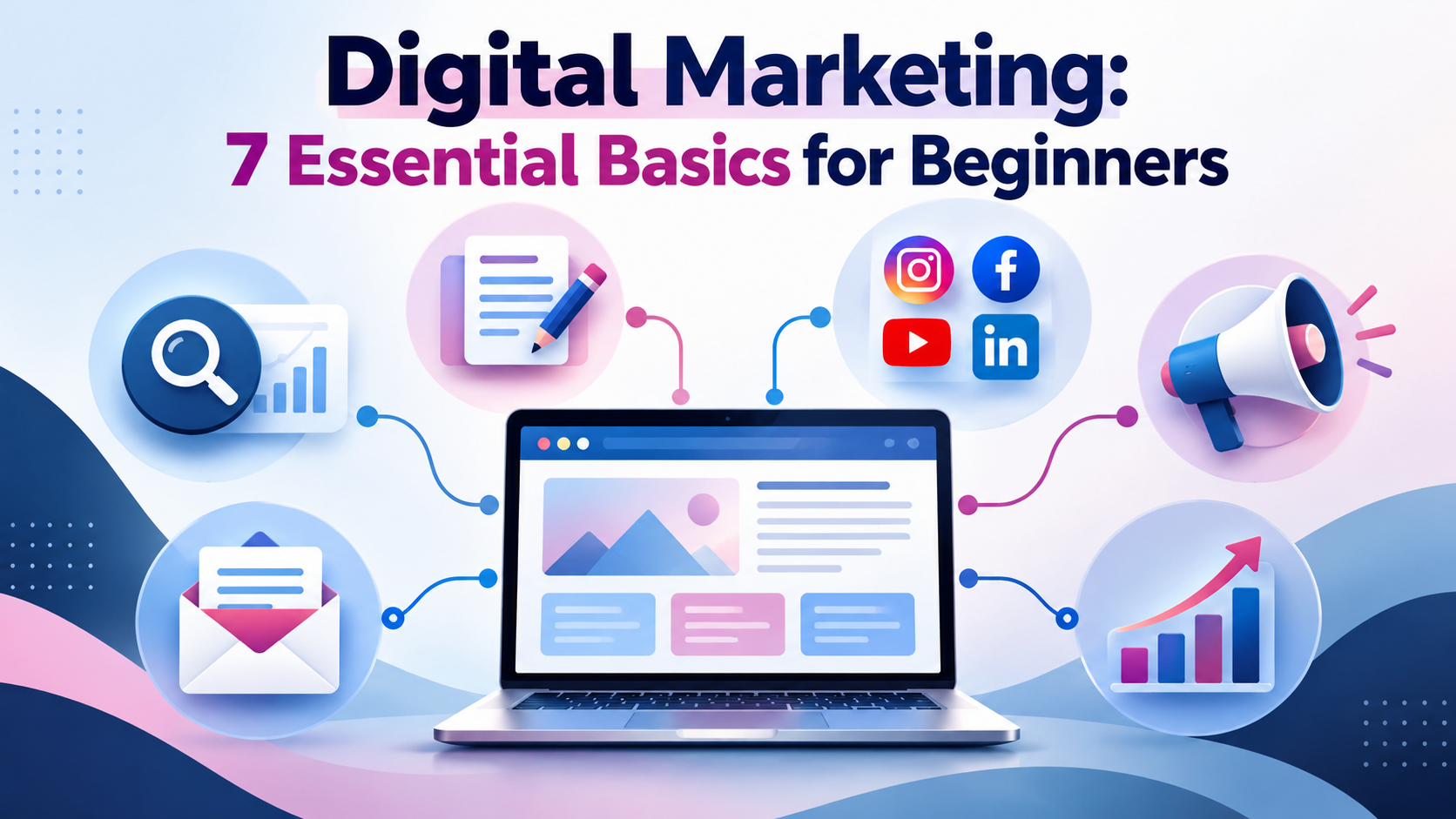
Digital marketing is the process of promoting products, services, or brands through digital channels such as search engines, websites, social media, email, and online advertising. It helps businesses reach relevant audiences, share useful information, attract potential customers, and measure their marketing performance.
For beginners, understanding the fundamentals is the first step toward creating effective online campaigns. You do not need to master every marketing channel immediately. Start with the basics, understand your audience, and learn how each channel supports a business goal.
In this guide, you will learn what digital marketing means, how it works, its main types, and how to start applying it in practice.
Table of Contents
- What Is Digital Marketing?
- How Does Digital Marketing Work?
- Seven Essential Types of Digital Marketing
- Why Is Digital Marketing Important?
- How to Start Learning Digital Marketing
- Common Mistakes Beginners Should Avoid
- Frequently Asked Questions
- Conclusion
1. What Is Digital Marketing?
Digital marketing uses internet-connected platforms and digital technologies to promote a business, product, service, or idea.
For example, imagine a local café that wants more customers. It could create a website, publish helpful content, maintain its Google Business Profile, share updates on social media, and run targeted online advertisements.
Each activity helps the café reach people in a different way. The right combination depends on its audience, budget, objectives, and resources.
Unlike traditional marketing methods such as printed flyers, digital channels can also provide measurable information about website visits, clicks, enquiries, and conversions.
2. How Does Digital Marketing Work?
A practical marketing process can be divided into five steps.
Step 1: Identify your target audience
Understand who you want to reach. Consider their needs, interests, location, problems, and online behaviour.
For example, a local clothing store might focus on people who shop for everyday fashion in its service area.
Step 2: Set a clear objective
Decide what you want your marketing activity to achieve. Possible objectives include increasing website traffic, generating enquiries, growing an email list, or increasing online sales.
Step 3: Choose suitable channels
Select the channels that match your goal. SEO may help attract people searching for information, while paid advertising can help promote a specific offer to a selected audience.
Step 4: Create useful content or campaigns
Publish content that answers questions, explains products, solves problems, or encourages a relevant action. Make sure the message matches the audience’s needs.
Step 5: Measure and improve
Review performance using appropriate analytics tools. Identify what is working, what needs improvement, and what should be tested next.
This process makes digital marketing more structured and helps businesses make decisions based on evidence rather than assumptions.
3. Seven Essential Types of Digital Marketing
1. Search Engine Optimization (SEO)
SEO involves improving a website and its content so search engines can understand its pages and users can discover relevant information through organic search results.
Common activities include keyword research, helpful content creation, on-page optimization, technical SEO, and improving internal links.
SEO is generally a longer-term activity. Results depend on factors such as competition, website quality, and how search engines crawl and evaluate pages.
2. Content Marketing
Content marketing focuses on creating and distributing useful material for a defined audience.
Examples include blog posts, educational articles, guides, videos, and infographics.
A well-planned content strategy answers real customer questions and can support other channels, including SEO and email marketing.
3. Social Media Marketing
Social media marketing uses platforms such as Instagram, Facebook, LinkedIn, and YouTube to share content, build awareness, interact with audiences, and promote relevant offers.
Businesses should choose platforms based on their audience and objectives instead of trying to maintain every platform at once.
4. Search Engine Advertising
Search engine advertising allows businesses to pay for ads that can appear in search results and other placements.
Google Ads is one example. Advertisers can select campaign objectives, audiences or search themes, budgets, and relevant landing pages.
Paid advertising can generate visibility quickly, but performance depends on targeting, competition, budget, and the quality of the campaign.
5. Email Marketing
Email marketing involves sending useful messages, newsletters, offers, or updates to people who have subscribed or otherwise provided appropriate permission.
It can help businesses nurture relationships, share new content, and communicate with existing customers.
6. Affiliate and Influencer Marketing
Affiliate marketing involves partners promoting products or services in exchange for an agreed commission or other arrangement.
Influencer marketing involves collaborating with creators whose audiences may be relevant to a brand. Businesses should assess audience relevance, authenticity, disclosure requirements, and campaign objectives.
7. Analytics and Conversion Optimization
Analytics helps marketers understand how people interact with their websites and campaigns. Conversion optimization focuses on improving the percentage of visitors who complete a desired action.
Examples include submitting a contact form, signing up for a newsletter, or purchasing a product.
These activities help businesses understand results and identify opportunities to improve performance.
4. Why Is Digital Marketing Important?
Digital channels give businesses several practical ways to communicate with potential customers.
- Audience reach: Businesses can reach people through search engines, websites, social platforms, and email.
- Measurable performance: Appropriate analytics tools can track relevant activity and outcomes.
- Flexible budgets: Campaigns can be adjusted to suit available resources.
- Audience relevance: Different messages can be developed for different audience needs.
- Continuous improvement: Businesses can review results and refine their campaigns.
However, using digital channels does not automatically guarantee sales or business growth. Effective marketing requires relevant offers, useful content, appropriate targeting, and ongoing evaluation.
5. How to Start Learning Digital Marketing
If you are a beginner, follow this practical learning plan.
- Learn the fundamentals. Understand marketing objectives, target audiences, and the customer journey.
- Start with SEO. Learn keyword research, search intent, on-page SEO, and basic technical SEO.
- Practise content creation. Write useful articles and develop simple content calendars.
- Explore social media. Learn how to plan posts, communicate with audiences, and measure engagement.
- Understand paid advertising. Study campaign structure, targeting, budgeting, and landing pages before spending money.
- Learn analytics. Explore Google Analytics 4 and Google Search Console to understand website performance.
- Build practical projects. Create sample campaigns, optimize a WordPress website, and document genuine results from your work.
You can develop your knowledge gradually. Focus on understanding why a marketing activity is useful instead of simply memorizing definitions.
6. Common Mistakes Beginners Should Avoid
Avoid these common problems when planning campaigns:
- Trying to learn every channel simultaneously without a clear priority.
- Publishing content without understanding the audience’s questions.
- Repeating keywords unnaturally to influence an SEO score.
- Running advertisements without a clear objective or suitable landing page.
- Ignoring mobile usability and website performance.
- Measuring likes or clicks without considering the actual business goal.
- Expecting immediate results from every marketing activity.
A simple strategy with clear objectives and regular evaluation is often more useful than an unnecessarily complicated plan.
7. Frequently Asked Questions
What is digital marketing in simple words?
It is the promotion of products, services, or brands through digital channels such as websites, search engines, social media, email, and online advertising.
What are the main types of digital marketing?
Common types include SEO, content marketing, social media marketing, paid advertising, email marketing, affiliate marketing, influencer marketing, and marketing analytics.
Is digital marketing suitable for beginners?
Yes. Beginners can start by learning the fundamentals and practising one area at a time. Understanding audiences, content, and measurement provides a useful foundation.
Do I need a website to start learning digital marketing?
A website is not essential for learning every marketing channel, but practising with a website helps you understand SEO, content publishing, analytics, and conversion optimization.
How long does it take to learn digital marketing?
The time required depends on your learning schedule, previous knowledge, and chosen specialization. Basic concepts can be learned before progressing to more advanced tools and practical projects.
8. Conclusion
Digital marketing combines different online channels to help businesses reach audiences, communicate value, and measure results. Understanding SEO, content marketing, social media, advertising, email, and analytics gives beginners a strong foundation for further learning.
Start with one topic, practise what you learn, and improve your approach using reliable information and real performance data.
Want to continue learning? Explore the upcoming beginner-friendly guides on SEO, keyword research, WordPress optimization, and content planning at Dhruvhub. Start with the topics that match your current learning goals and build your knowledge step by step.
Leave a Reply